
Introduction: The Secret Every Dog Owner Misses
Every dog owner dreams of having a calm, well-behaved, and emotionally balanced pet. But what if the real secret to achieving this harmony doesn’t come from endless physical exercise or expensive training sessions? What if it comes from a mental workout a genius technique revealed by an experienced Pet Trainer that most owners completely overlook?
This article dives deep into the concept of canine mental workouts: what they are, how they transform behavior, and why experts insist that this simple shift can change your dog’s life and yours too.
The Hidden Power of a Dog’s Mind
Dogs are intelligent, emotionally complex animals that are more than just bundles of energy. However, most dog owners don’t realize how much cerebral stimulation a dog actually needs.
An expert pet trainer clarifies that a dog that is exhausted may not be content or well-rounded. They claim that “exercise alone won’t prevent boredom or anxiety.” “Dogs must use their minds as much as their bodies.”
Dogs yearn for cerebral work, much as people grow restless in the absence of problems. If they don’t get this stimulation, they could start digging, biting furniture, or barking excessively. By revealing your dog’s latent intelligence, the brilliant mental exercise you’re about to learn solves this precise problem.
What Exactly Is a Dog’s Mental Workout?
A mental workout is an activity that challenges a dog’s brain through problem-solving, focus, and sensory engagement. It’s not about physical strength, it’s about mental agility.
Think of it as a “brain gym” for dogs. Instead of running laps around the park, your dog engages in tasks that make them think, choose, and learn. A professional Pet Trainer emphasizes that these exercises build confidence, patience, and emotional stability.
The best part? You don’t need expensive tools or advanced training. With the right guidance, you can start today in your living room.
Why Most Owners Ignore Mental Workouts
Many pet owners assume that a daily walk is enough for their dog’s happiness. However, walks satisfy physical needs but rarely challenge the mind, especially if the route remains the same.
Another reason is a lack of awareness. Traditional advice focuses heavily on obedience and exercise rather than cognitive enrichment. “Mental workouts are the missing link in most dog routines,” says one leading pet trainer. “Owners often focus on ‘sit’ and ‘stay,’ but the dog’s brain wants more complex tasks.”
Ignoring mental stimulation can lead to restlessness and emotional imbalance. It’s like feeding a smart child the same puzzle every day; boredom sets in quickly.
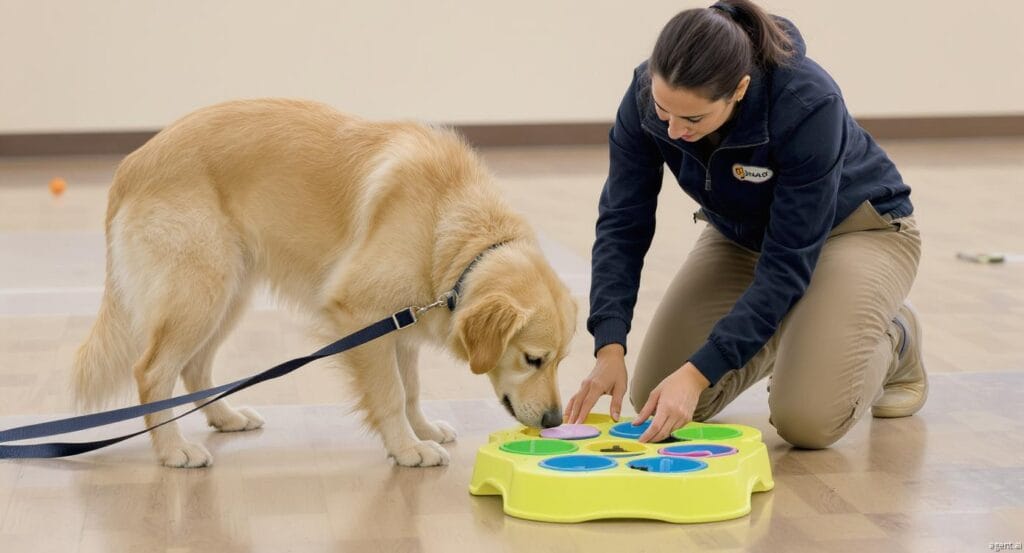
The Genius Technique: The “Seek and Solve” Method
Among all the mental exercises experts recommend, the Seek and Solve” method stands out. It’s a proven approach developed by professional trainers and supported by animal behavior studies.
Step 1: Engage the Senses
Hide a few of your dog’s favorite treats or toys around the house or yard. Allow your dog to sniff them out using their natural hunting instincts.
This sensory engagement sharpens your dog’s mind, forcing them to think, plan, and track, just as their ancestors did in the wild.
Step 2: Add a Challenge
Increase difficulty gradually. Hide the object in trickier places or introduce verbal clues. A Pet Trainer suggests using commands like “find it” or “search.”
This not only boosts cognitive function but also strengthens communication between you and your dog.
Step 3: Reward Problem-Solving
Each successful discovery should bring positive reinforcement, a treat, a toy, or simple praise. The reward signals to your dog that mental effort leads to success, building confidence and trust.
Scientific Proof That Mental Exercise Works
Behaviorists and veterinarians have long studied the effects of mental stimulation on canine health. Research published in the Journal of Veterinary Behavior found that mentally engaged dogs show reduced stress levels, better focus, and fewer behavioral issues.
A certified Pet Trainer highlights how cognitive enrichment increases serotonin, the “happiness chemical,” in dogs’ brains. This means a mentally active dog is not only calmer but also more emotionally stable.
In shelters, mental workouts have even been shown to improve adoptability by making dogs more attentive and sociable.
The Emotional Benefits for Dogs and Owners
Mental exercises have benefits beyond compliance. They foster a stronger emotional connection between people and their pets. Your dog feels accomplished when they follow a scent trail or solve a puzzle. Participating in that journey also fosters mutual trust. It’s explained wonderfully by an experienced pet trainer: “Mental exercise transforms training into teamwork.” The dog begins to view you as a companion rather than a boss.
Simple Mental Workouts You Can Try at Home
You don’t need fancy tools or extra space to start. Here are simple, trainer-approved activities you can do daily.
1. The Snuffle Mat Game
Sprinkle treats in a snuffle mat or a rolled-up towel. Your dog must use their nose to find them. It engages their strongest sense and promotes calm focus.
2. Treat Puzzle Toys
These toys make your dog figure out how to get a treat out of a container. They stimulate critical thinking and fine motor skills.
3. Hide-and-Seek
Hide in another room and call your dog’s name. When they find you, reward them. This encourages recall and problem-solving.
4. Toy Rotation
Keep a small selection of toys visible and rotate them weekly. The novelty keeps your dog’s curiosity alive.
5. Obedience Variations
Instead of repeating “sit” and “stay,” try commands in new orders or environments. This improves flexibility and adaptability.

How Mental Workouts Solve Common Behavior Problems
Excessive Barking
A mentally tired dog barks less. Engaging their brain redirects energy away from unwanted vocalization.
Separation Anxiety
Puzzle games while you’re away can calm your dog’s nerves and keep them occupied.
Chewing and Destruction
Mental engagement replaces boredom-driven chewing with purposeful activities.
Aggression and Impulsivity
Problem-solving activities teach patience and self-control, two critical traits for emotional balance.
According to one pet trainer, “Behavioral issues are often symptoms of mental neglect. Once the mind is engaged, the problem fades.”
Creating a Balanced Routine: The 3E Formula
The 3E Formula, developed by professional trainers, combines exercise, enrichment, and engagement for complete well-being.
- Exercise: Daily walks or play for physical energy release.
- Enrichment: Mental workouts and new experiences to challenge the brain.
- Engagement: Quality time that builds trust and communication.
A Pet Trainer recommends at least 15–20 minutes of mental workouts daily alongside regular physical activity.
How Long Before You See Results?
Most owners notice a difference within a week. Dogs become calmer, more responsive, and emotionally stable. The transformation isn’t just behavioral; it’s neurological.
As one certified Pet Trainer points out, “A mentally stimulated dog processes stress differently. Their threshold for frustration increases, and their confidence grows.”
Consistency is the key. Just as muscles develop with regular workouts, the canine brain sharpens with repetition and challenge.
The Trainer’s Toolkit: Must-Have Mental Workout Accessories
While many exercises need no tools, these items can elevate your training experience:
- Interactive treat puzzles
- Snuffle mats
- Kong toys or slow feeders
- Clickers for precision training
- Scent kits for nose work practice
A trusted Pet Trainer advises choosing toys based on your dog’s breed and problem-solving ability. For example, Border Collies thrive on logic puzzles, while Beagles excel in scent-based games.
Common Mistakes to Avoid
- Overwhelming the Dog: Start simple; frustration kills motivation.
- Inconsistent Training: Regularity matters more than intensity.
- Ignoring Praise: Verbal rewards strengthen trust.
- Skipping Rest Periods: Mental fatigue is real. Dogs need downtime.
- Expecting Instant Results: Patience ensures lasting change.
A skilled Pet Trainer reminds owners that progress builds over time, just like human learning.
Expert Insights: What Professional Pet Trainers Say
Across the industry, experts agree that mental stimulation is the cornerstone of modern training.
- “You can walk a dog five miles, but five minutes of brain work can do more for behavior,” says behaviorist and Pet Trainer Jenna Lewis.
- “Mental workouts turn obedience into joy,” adds canine specialist Marcus Holt. “It’s not about control; it’s about connection.”
Also Read: White Iberian Lynx: Rare Discovery and Conservation Success

These professionals highlight one truth: the smartest training is the most mindful one.
The Global Trend of Cognitive Canine Training
Mental fitness has emerged as a global pet wellness trend in recent years. Owners are switching from dominance-based strategies to enrichment-based strategies from Tokyo to Toronto.
These days, conventional programs for pet trainers include games, scent trails, and problem-solving exercises. The rise of mindfulness in human health is reflected in this evolution; balanced thoughts lead to balanced conduct.
Transformative Stories: Real-Life Success Cases
- Case 1: Luna the Labrador
Luna’s owners struggled with chewing and restlessness. Within two weeks of starting daily puzzle games, her anxiety dropped dramatically. - Case 2: Max the German Shepherd
Max’s aggression toward strangers eased after introducing “seek and solve” routines. His Pet Trainer reported calmer interactions and improved focus. - Case 3: Bella the Rescue Dog
A shy rescue, Bella gained confidence through simple scent-based games. Her owner now calls her transformation “miraculous.”
These stories prove that cognitive training isn’t a luxury; it’s a necessity.
Long-Term Benefits for You and Your Dog
When your dog’s mind stays sharp, everything changes:
- Stronger bond and communication
- Fewer behavioral issues
- Improved obedience and focus
- Happier, calmer demeanor
- Enhanced confidence and adaptability
A dedicated Pet Trainer calls it “a life upgrade, not just a trick.”
Conclusion: The Ignored Secret That Changes Everything
Most dog owners believe love and walks are enough. But real transformation happens when the mind gets to work.
The genius mental workout revealed by professional Pet Trainers is simple, powerful, and often ignored. Yet, it’s the bridge between frustration and the key to unlocking your dog’s full potential.
Start today. Ten minutes of mental engagement could change your dog’s entire world and yours, too.
FAQs
1. What does a Pet Trainer mean by a mental workout for dogs?
A Pet Trainer describes it as an activity that challenges a dog’s brain through focus, scent, and problem-solving tasks to improve behavior and emotional balance.
2. How often should I give my dog mental workouts?
Pet Trainers recommend 15–20 minutes daily, split into short, engaging sessions.
3. What are the signs my dog needs mental stimulation?
Chewing, barking, digging, and restlessness are signs your dog needs more brain challenges.
4. Can mental workouts replace physical exercise?
No, both are essential. Mental workouts complement physical exercise for total well-being.
5. Are mental workouts good for all dog breeds?
Yes, every breed benefits. Smart breeds like Collies and Poodles need more complex games.
6. What are some easy mental workouts to start with?
Try scent games, treat puzzles, snuffle mats, and hide-and-seek to begin.
7. How soon will I see changes in my dog’s behavior?
Most owners notice calmer and more focused behavior within one to two weeks.
8. Can mental workouts reduce anxiety in dogs?
Yes, mental games reduce stress by keeping the dog’s brain busy and confident.
9. Do I need a Pet Trainer to start mental workouts?
Not always, but a Pet Trainer can create a custom plan suited to your dog’s needs.
10. What’s the biggest mistake owners make?
Starting too hard or expecting quick results; keep it simple and consistent for success.
Also Read: Shocking Dog Owner Mistakes That Secretly Cut Years Off Your Dog’s Lifespan