Introduction
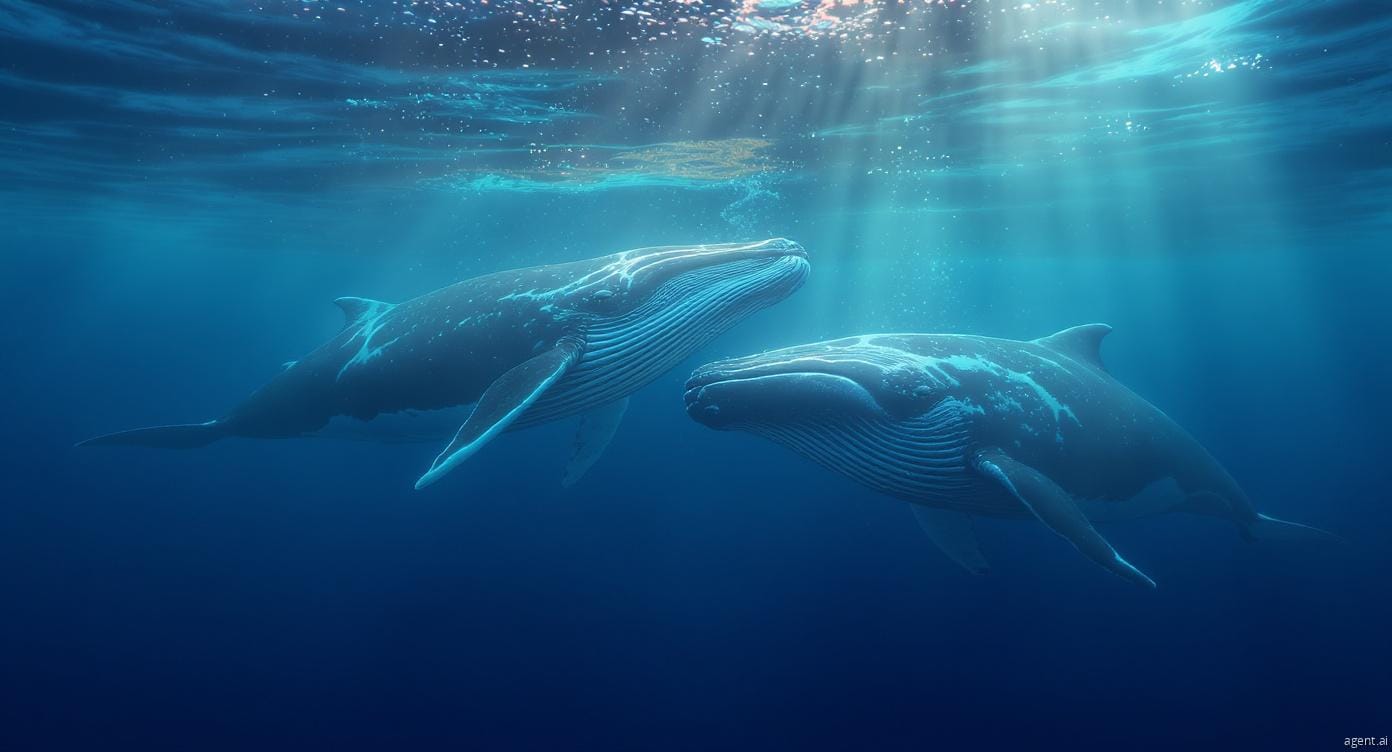
Whales have fascinated humans for centuries. Their size, intelligence, deep-ocean lifestyle, and complex behavior patterns place them among the most mysterious creatures on the planet. But the most remarkable aspect of these magnificent giants is their unique communication system. Many people compare animal communication to that of domestic pets, especially dogs and cats, because these animals live close to humans and clearly express their emotions. Yet the communication abilities of a whale are far more dynamic, intricate, and powerful than what we experience with common pets.
This article explores ten astonishing facts about how whales communicate, why their methods may be more advanced than dogs and cats, and what makes their underwater world one of the most complex social environments on Earth. Each fact reveals something extraordinary, something that shows why the whale stands out as a natural communicator on a different level entirely.
From emotional connections to long-distance conversations, from cultural evolution to complex vocal patterns, the whale proves again and again that intelligence isn’t limited to land animals. Instead, the ocean carries secrets we have only begun to understand.
Let’s begin the journey deep into the world of whale communication and uncover how these giants may surpass dogs and cats in subtlety, sophistication, and long-range intelligence.
Also Read: 10 Warning Signs in Dogs Veterinarians Say You Must Never Ignore | Even One Could Save a Life
1. Whale Sounds Travel Thousands of Miles, A Superpower Dogs & Cats Do Not Have
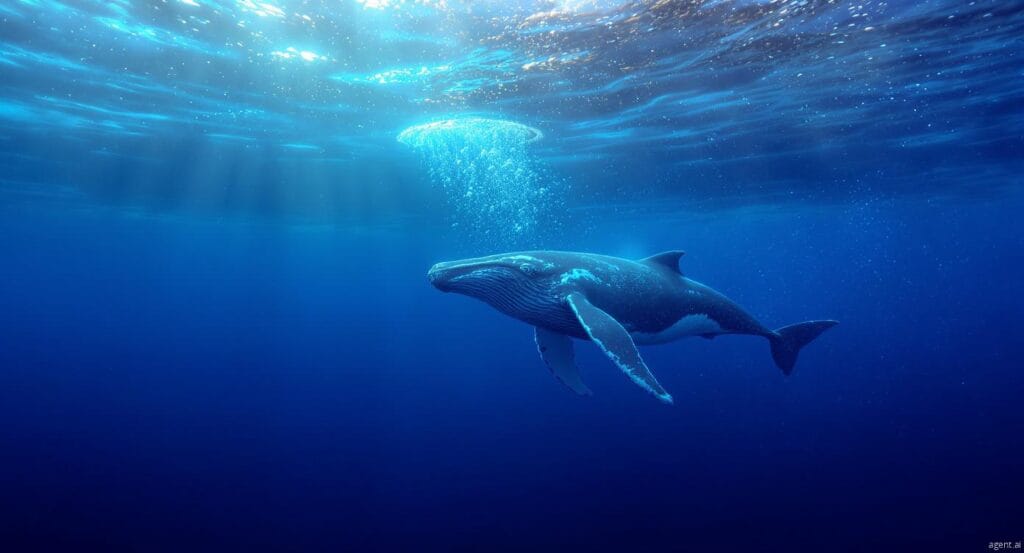
The extraordinary distance across which these ocean giants can transmit sound remains one of the most fascinating aspects of their communication system. Many species use deep, low-frequency calls that move smoothly through water, sometimes traveling hundreds or even thousands of miles under the right conditions.
In contrast, pets like dogs and cats communicate only within limited ranges. Even a powerful bark rarely reaches beyond a few hundred meters, and feline sounds are mostly meant for close, intimate spaces. Their communication is effective, but restricted to their immediate environment.
These marine mammals, however, treat sound as a true superpower, allowing them to stay connected with distant groups, locate potential partners, and coordinate movements across vast stretches of the sea. While household animals rely mainly on sight, scent, and short-range vocal cues, life underwater demands an entirely different strategy.
In the ocean’s dark, low-visibility environment, long-distance acoustic signaling becomes essential. Social bonding, emotional expression, navigation, and survival all depend on these far-reaching calls. This highly evolved underwater communication network operates on a scale that land-based pets simply cannot match.
Also Read: Dog Trainer Warns: 5 Dog Breeds You Should Avoid | But Here’s the Twist!
2. Whale Songs Are Structured Like Music, Far More Complex Than Pet Vocalization
Dogs bark. Cats meow. While their sounds carry meaning, they lack structured patterns. In contrast, a whale, particularly the humpback whale, creates complex songs that follow patterns similar to music. These songs contain units, phrases, verses, and sections arranged in intricate sequences.
A whale modifies its song over time. Entire populations learn and adapt to these changes, passing them across generations. This cultural transfer of sound is extraordinary. Dogs learn through observation and training, and cats learn through instinct and conditioning. But a whale participates in vocal traditions, something extremely rare in the animal kingdom.
These songs often last between 20 minutes and an hour, and some whales repeat them for days. The rhythmic patterns, tonal changes, and melodic structures have baffled scientists for decades. Some researchers compare whale songs to human musical compositions, though they are created with an entirely different biological mechanism. (For a deeper look into how these ocean mammals create songs and interact socially, you can explore National Geographic’s detailed research.)
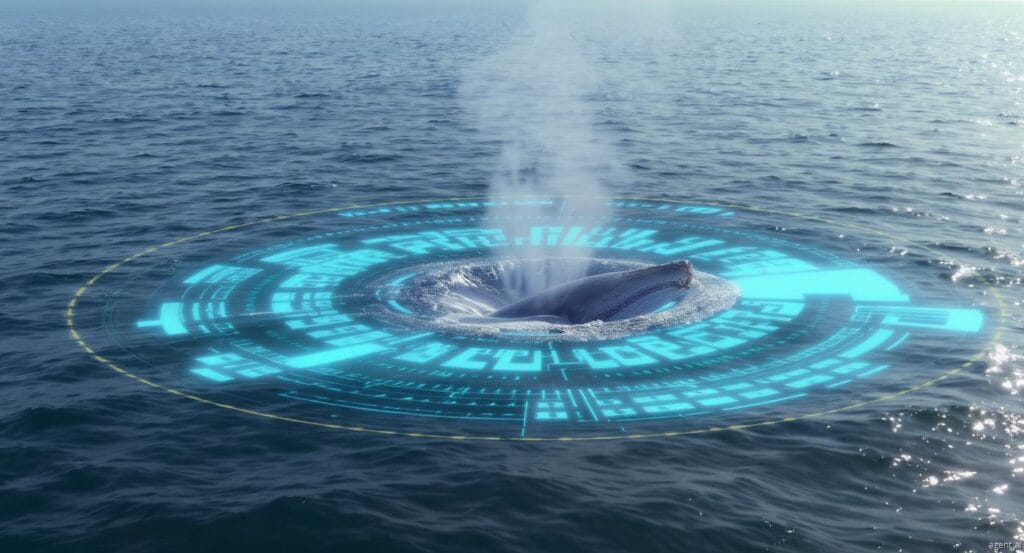
While dogs express feelings through sounds and cats communicate emotional states, a whale uses patterned sound sequences that serve multiple purposes: navigation, mating, social bonding, territory signaling, and even emotional expression.
This musical dimension elevates whale communication above ordinary vocal messaging.
3. Whales Use Body Language on a Massive Scale
Dogs demonstrate surrender by crouching, tilting their heads, or wagging their tails. To express their intentions, cats can arch their backs, flick their tails, or narrow their eyes. Although they are restricted to minor bodily gestures, these body languages are crucial.
On the other hand, a whale uses its entire body to communicate, sending impulses strong enough to produce waves. Meaningful behaviors include spyhopping, bubble blowing, tail slapping, fin slapping, and breaching. Every movement conveys a different message, such as eagerness, caution, playfulness, or distress.
A whale may be demonstrating dominance, expressing happiness, cleaning its skin, or indicating a shift in the group’s direction when it breaches, launching its enormous body out of the water. A whale uses its entire body to transmit physical messages across great distances, whereas dogs express their excitement by sprinting or jumping.
The degree to which communication is ingrained in whale behavior is demonstrated by the size of their body language.
Also Read: 10 Proven Ways to Help Your Pet Lose Weight Fast Without Stress or Guilt
4. Whales Have Emotional Depth Comparable to Humans, Beyond Dogs & Cats
Dogs and cats are emotionally expressive animals, often deeply tuned to human feelings. A dog can sense distress and respond with comfort, while a cat easily detects calmness, tension, or fear. Their emotional intelligence is well-known, and that’s what makes the human–pet bond so powerful.
But the emotional world of the giants of the sea stretches far beyond what most domestic animals display. These ocean dwellers mourn the loss of a newborn, sometimes carrying the little one for days. Entire groups have been observed forming protective circles around injured or dying members, showing a level of social grief rarely seen on land. Many of these marine beings maintain long-term relationships, recognize companions even after years, and display deep affection through touch, sound, and coordinated movement.
There are also remarkable accounts of these creatures helping those in distress, nudging injured individuals to the surface for air or even shielding humans from predators. Their empathy is not limited to their own species.
This emotional depth is tightly interwoven with their communication style. Through patterned calls, subtle tones, rhythmic signals, and physical gestures, these marine giants convey sadness, fear, curiosity, affection, and even joy. Their emotional intelligence operates at a community level, not only at the personal scale we see in dogs and cats.
5. Whale Communication Is Linked With Culture, Something Pets Do Not Display
Learned behaviors that are passed down through the generations are referred to as culture. Dogs pick up behaviors and habits from people. Cats pick up knowledge from their surroundings. However, whales’ communication is infused with cultural systems.
Whale pods can have unique hunting methods, dialects, and even song differences. Over time, these behaviors change. The older whales teach the younger ones.
Dogs exhibit breed-specific tendencies. Natural patterns are displayed by cats. However, just as people absorb cultural norms within communities, whales also adopt the cultural customs of their community.
Whales can adapt to shifting habitats and preserve social cohesiveness throughout generations thanks to cultural transmission.
6. Whales Communicate Through Echolocation, A Sensory Ability Far Beyond Pets
Echolocation is one of the most sophisticated tools used by certain marine mammals—particularly toothed species such as sperm whales, orcas, and dolphins. By releasing rapid clicks that bounce off nearby objects, these creatures create a detailed mental picture of everything around them.
Dogs depend mainly on sight, scent, and basic hearing. Cats depend on sharp vision, whisker sensitivity, and quick reflexes. But animals of the deep use echoes as their primary guide, effectively transforming sound into a three-dimensional image.
This means these ocean dwellers don’t just communicate, they perceive the world through sound. It’s a sensory ability far beyond anything household pets can replicate.
Echolocation helps whales:
- Hunt in deep darkness
- Avoid underwater obstacles
- Locate pod members
- Coordinate complex group hunts
- Communicate distances and directions
No pet on land has such an advanced sensory communication system.
Research shows that many species show advanced group intelligence and complex bonding patterns. For deeper scientific insights, you can check the (Whale & Dolphin Conservation (WDC) – Social Intelligence of Whales.)
Also Read: White Iberian Lynx: Rare Discovery and Conservation Success
7. Whale Pods Have Social Hierarchies Built on Sound-Based Leadership
Dogs can comprehend hierarchies based on submission and dominance. Cats are loosely organized, independence-oriented hierarchies based on territory. However, whale pods use a leadership system based on sound.
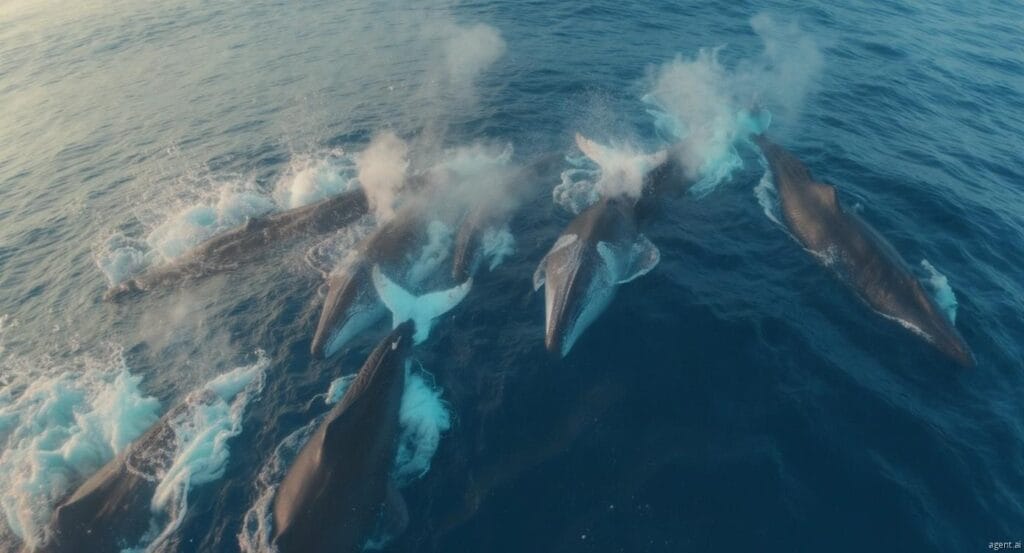
A dominant whale may use specific vocal patterns to guide the group. Mothers guide their calves with gentle noises. To coordinate their hunting tactics, pods employ unique calls. Whales take on leadership roles through social influence, maturity, and experience rather than just physical superiority.
Compared to pet behavior, whale civilization is more like human communities due to its sound-oriented social structure.
8. Whale Communication Adapts to Changing Ocean Conditions
Unlike dogs and cats, whose communication remains stable, a whale must adapt constantly. Ocean noise, from ships, sonar, drilling, and machinery, interferes with natural communication. This forces whales to modify their vocal frequencies, call volume, and patterns to overcome noise pollution.
Some whales have been recorded shouting, raising their vocal volume to be heard across increasing noise. Others alter pitch or adopt new sound patterns entirely.
Dogs and cats do not face such environmental pressure on their communication systems. Whales must refine and evolve their communication to survive.
This adaptability shows intelligence beyond instinct.
9. Whales Teach Communication to Their Young Over Years, Similar to Humans, Not Pets
Dogs pick things up fast. A cat picks up knowledge through experience. However, it takes years for a whale calf to master the language of its species.
Calves learn to travel, call, react, and interpret social cues from their mothers. Pods facilitate instruction by encouraging group participation. Compared to the growth of household pets, this extended learning more closely resembles human childhood.
Whale calves need continuous sound communication for emotional connection, safety, and direction.
The depth of communication in whale culture is demonstrated by this prolonged learning time.
10. Communication Is a Lifeline for Ocean Mammals, Not Just an Emotional Tool
Dogs and cats communicate mainly to express basic emotions, intentions, and social comfort. Their vocal and physical signals strengthen bonding, improve interaction, and help them navigate life with humans. But their survival does not depend entirely on communication.
Deep-sea giants, however, rely on sound for almost every aspect of life. For these ocean mammals, communication is not just expression; it is a fundamental survival mechanism. The signals they exchange help them accomplish tasks that land animals never have to deal with on such a scale. (For additional scientific information, you can also explore research from NOAA.)
These underwater communicators depend on sound for:
- Navigation
- Reproduction
- Tracking food
- Long-distance migration
- Teaching and guiding calves
- Maintaining social structure
- Emotional and social bonding
- Protecting the group from threats
Without these long-range signals, these creatures would struggle to move, feed, breed, or remain connected across large ocean territories. Their world is shaped by sound, and every aspect of their life depends on their ability to send and interpret acoustic messages.
This makes their communication system deeply evolved and far more survival-oriented than the simple emotional expressions seen in domestic pets.
Conclusion: Why Their Communication System Surpasses Dogs & Cats
The way these marine giants interact reveals a complex, layered, and highly adaptive communication structure. While pets like dogs and cats show affection, respond to human cues, and display emotional intelligence, their communication remains limited by distance, biology, and instinct.
By contrast:
- These ocean mammals exchange signals across vast distances
- They use structured sequences that resemble musical patterns
- Distinct groups develop unique dialects
- Young ones spend years learning proper vocal behavior
- Sound guides every major aspect of their existence
Together, these features place their communication abilities among the most sophisticated in the natural world, possibly even comparable to the early stages of human linguistic evolution.
These deep-ocean communicators remind us that intelligence and social complexity are not confined to land. Sometimes, the greatest insights into communication lie far below the surface, carried through the mysterious echoes of the sea.
FAQ
1. Can these marine mammals communicate better than household pets?
Many ocean species use long-range calls and patterned signals, which makes their communication far more complex than the short-range vocal cues used by dogs and cats.
2. Do deep-sea animals really sing underwater?
Yes, some species produce structured songs made of repeating phrases, rhythms, and acoustic patterns that function like a form of social communication.
3. How far can underwater calls travel?
Low-frequency signals can travel across hundreds of miles because sound moves efficiently through seawater.
4. Do these ocean giants express emotions through sound?
They often show grief, affection, excitement, and stress through vocal tones and coordinated body movements.
5. Can individuals recognize each other after many years?
Research suggests they identify companions through unique vocal signatures and long-term memory.
6. Is echolocation only for finding objects?
It’s primarily a navigation tool, but the clicks also deliver information about identity, distance, and intent.
7. Why is sound more important underwater than vision?
Deep waters are dark and murky, so audio signals become the most reliable method for navigating and social bonding.
8. Do young calves learn communication from adults?
Yes, juveniles slowly acquire group-specific calls and social rules, similar to cultural learning in human families.
9. Are there examples of ocean mammals helping humans?
Several reports describe them shielding divers from predators or guiding lost swimmers, indicating high awareness and empathy.
10. Why do scientists consider their communication advanced?
It includes long-distance signaling, emotional expression, cultural learning, and multi-layered acoustic structures rarely seen in land animals.